
Last Updated on August 16, 2026 by KnownSense
Membership inference attacks threaten AI privacy by revealing whether a specific record was used to train a machine learning model. An attacker may not recover the entire record, but confirming membership can itself expose sensitive facts. If a model was trained on patients from a genetic-disease study, for example, learning that someone belongs to its training set could disclose private health information.
This article explains how membership inference works, why overfitted models are especially vulnerable, and how organizations can reduce the risk. It also examines evasion attacks, a different class of adversarial attack that manipulates model inputs at inference time.
Responsible-use note: Run the demonstrations in this article only against models and datasets you own or are authorized to test. They are intended for security education and defensive evaluation.
What Are Membership Inference Attacks?
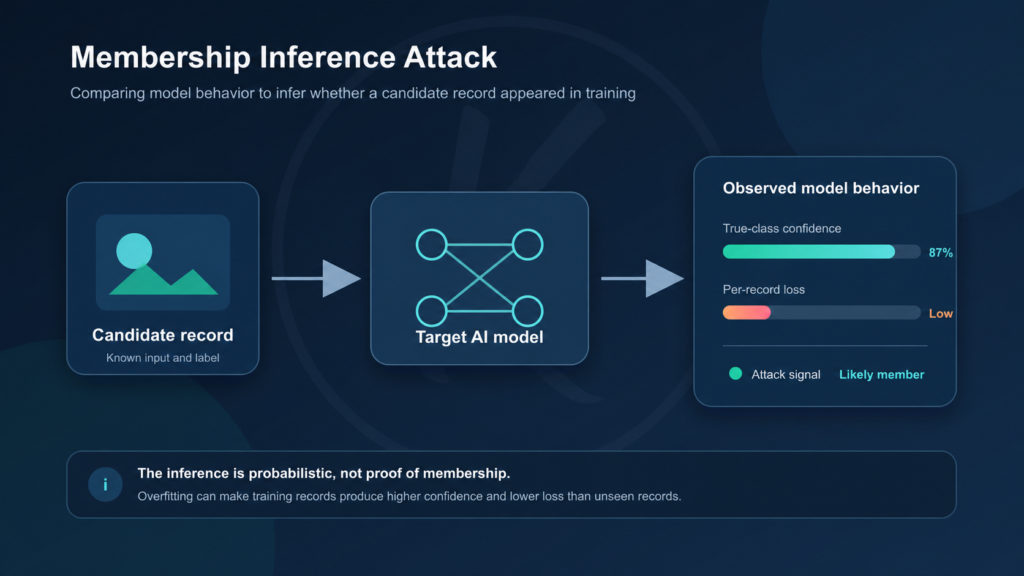
A membership inference attack tries to answer one question: Was this particular data point included in the model’s training set?
The attacker queries a trained model and studies its response. Depending on the access available, that response might include predicted probabilities, confidence scores, logits, losses, or only a predicted class. Models often behave differently on records they saw during training. A model may assign a training record unusually high confidence or unusually low loss, particularly when it has memorized details instead of learning patterns that generalize. An attacker can exploit that behavioral gap to estimate whether the record was a member or non-member of the training set.
How a Membership Inference Attack Works
A common black-box attack follows these steps:
- The attacker obtains candidate records and can query the target model.
- The attacker observes model outputs such as probabilities or confidence scores.
- The attacker builds a decision rule that distinguishes members from non-members.
- The attacker assigns a membership score or binary membership prediction to each candidate.
One simple rule labels a correctly classified record as a member when its loss is below a threshold. More advanced attacks train a separate binary classifier using shadow models.
A shadow model imitates the target model. Because the attacker controls the shadow model’s training data, they know which examples are members and which are non-members. They collect the shadow model’s outputs for both groups and use those labeled outputs to train an attack classifier. The resulting classifier is then applied to outputs from the target model.
The attacker’s classifier must predict membership, not the original image class. This distinction is important: an image classifier predicts labels such as cat or truck, while a membership classifier predicts member or non-member.
Using CIFAR-10 for the Membership Inference Attack
CIFAR-10 is the dataset we will use to demonstrate a membership inference attack. It contains 60,000 32-by-32 color images across ten classes: airplane, automobile, bird, cat, deer, dog, frog, horse, ship, and truck. Its standard split includes 50,000 training images and 10,000 test images.
The dataset’s small images make it practical for teaching and experimentation without requiring substantial computing resources. However, this simplified example should not be treated as a substitute for a production privacy assessment.
The following setup loads CIFAR-10 and separates data for a target model and a shadow model. A fixed random seed makes the split reproducible.
import torch
import torch.nn as nn
import torch.nn.functional as F
import torch.optim as optim
from torch.utils.data import DataLoader, random_split
from torchvision import datasets, transforms

torch.manual_seed(42)
device = torch.device("cuda" if torch.cuda.is_available() else "cpu")

transform = transforms.Compose([
    transforms.ToTensor(),
    transforms.Normalize((0.5, 0.5, 0.5), (0.5, 0.5, 0.5)),
])

full_train = datasets.CIFAR10(
    root="./data", train=True, download=True, transform=transform
)
test_dataset = datasets.CIFAR10(
    root="./data", train=False, download=True, transform=transform
)

target_train, shadow_train = random_split(full_train, [40000, 10000])

target_loader = DataLoader(target_train, batch_size=64, shuffle=True)
shadow_loader = DataLoader(shadow_train, batch_size=64, shuffle=True)
test_loader = DataLoader(test_dataset, batch_size=64, shuffle=False)
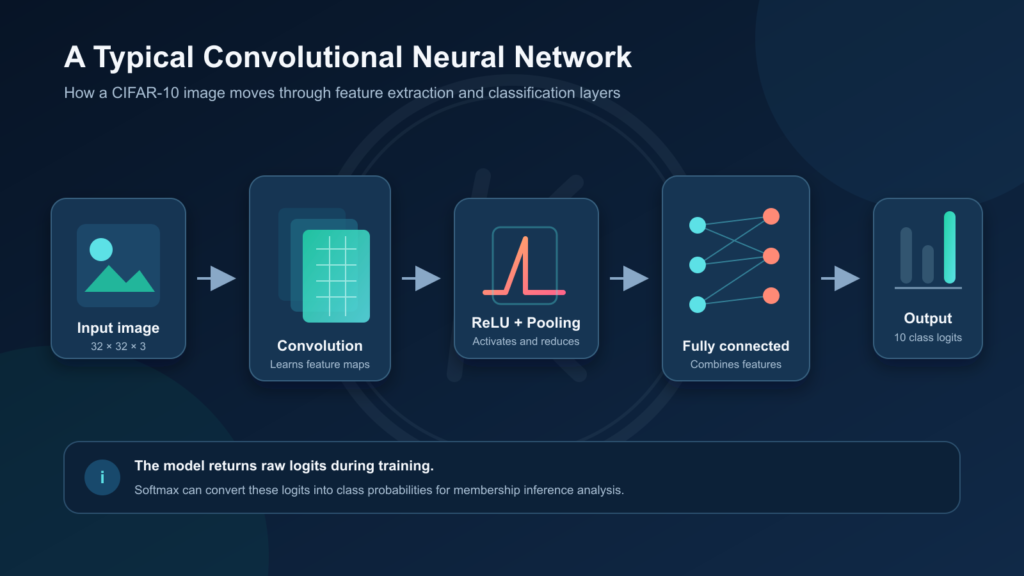
The target and shadow models can use the same compact convolutional neural network (CNN):
class Net(nn.Module):
    def __init__(self):
        super().__init__()
        self.conv1 = nn.Conv2d(3, 6, 5)
        self.pool = nn.MaxPool2d(2, 2)
        self.conv2 = nn.Conv2d(6, 16, 5)
        self.fc1 = nn.Linear(16 * 5 * 5, 120)
        self.fc2 = nn.Linear(120, 84)
        self.fc3 = nn.Linear(84, 10)

    def forward(self, x):
        x = self.pool(F.relu(self.conv1(x)))
        x = self.pool(F.relu(self.conv2(x)))
        x = torch.flatten(x, 1)
        x = F.relu(self.fc1(x))
        x = F.relu(self.fc2(x))
        return self.fc3(x)
CNNs preserve spatial relationships while learning features such as edges, textures, and shapes. Their main building blocks are convolutional layers, nonlinear activation functions such as ReLU, pooling layers, fully connected layers, and an output layer. In PyTorch, CrossEntropyLoss expects raw logits, so the model does not need to apply softmax during training.
Training the Target and Shadow Models
A reusable training function keeps the target and shadow procedures consistent:
def train_model(loader, epochs=10):
    model = Net().to(device)
    criterion = nn.CrossEntropyLoss()
    optimizer = optim.SGD(model.parameters(), lr=0.001, momentum=0.9)

    model.train()
    for _ in range(epochs):
        for inputs, labels in loader:
            inputs, labels = inputs.to(device), labels.to(device)
            optimizer.zero_grad()
            loss = criterion(model(inputs), labels)
            loss.backward()
            optimizer.step()

    return model

target_model = train_model(target_loader)
shadow_model = train_model(shadow_loader)
For a rigorous shadow-model experiment, the shadow model should also have known non-member data drawn from a distribution similar to its training data. The test set serves that educational purpose below.
A Corrected Membership Inference Proof of Concept
This simplified attack uses two features from each shadow-model response:
- The model’s probability for the record’s true class
- The record’s cross-entropy loss
It labels shadow-training records as 1 and held-out records as 0, then trains a small binary attack model.
class AttackModel(nn.Module):
    def __init__(self):
        super().__init__()
        self.layers = nn.Sequential(
            nn.Linear(2, 16),
            nn.ReLU(),
            nn.Linear(16, 1),
        )

    def forward(self, x):
        return self.layers(x).squeeze(1)


def collect_attack_features(model, loader, membership_label):
    features = []
    membership = []
    model.eval()

    with torch.no_grad():
        for inputs, labels in loader:
            inputs, labels = inputs.to(device), labels.to(device)
            logits = model(inputs)
            probabilities = F.softmax(logits, dim=1)
            true_class_probability = probabilities.gather(
                1, labels.unsqueeze(1)
            ).squeeze(1)
            per_sample_loss = F.cross_entropy(
                logits, labels, reduction="none"
            )

            batch_features = torch.stack(
                [true_class_probability, per_sample_loss], dim=1
            )
            features.append(batch_features.cpu())
            membership.append(
                torch.full((labels.size(0),), membership_label)
            )

    return torch.cat(features), torch.cat(membership)


shadow_member_x, shadow_member_y = collect_attack_features(
    shadow_model, shadow_loader, 1.0
)
shadow_nonmember_x, shadow_nonmember_y = collect_attack_features(
    shadow_model, test_loader, 0.0
)

attack_x = torch.cat([shadow_member_x, shadow_nonmember_x])
attack_y = torch.cat([shadow_member_y, shadow_nonmember_y])
attack_loader = DataLoader(
    torch.utils.data.TensorDataset(attack_x, attack_y),
    batch_size=128,
    shuffle=True,
)

attack_model = AttackModel().to(device)
attack_optimizer = optim.Adam(
    attack_model.parameters(), lr=0.001
)
attack_criterion = nn.BCEWithLogitsLoss()

attack_model.train()
for _ in range(10):
    for features, membership in attack_loader:
        features = features.to(device)
        membership = membership.to(device)
        attack_optimizer.zero_grad()
        loss = attack_criterion(attack_model(features), membership)
        loss.backward()
        attack_optimizer.step()
To evaluate the attack, collect features from known members of the target model and known non-members, then measure binary membership accuracy:
target_member_x, target_member_y = collect_attack_features(
    target_model, target_loader, 1.0
)
target_nonmember_x, target_nonmember_y = collect_attack_features(
    target_model, test_loader, 0.0
)

evaluation_x = torch.cat([target_member_x, target_nonmember_x]).to(device)
evaluation_y = torch.cat([target_member_y, target_nonmember_y]).to(device)

attack_model.eval()
with torch.no_grad():
    membership_probability = torch.sigmoid(attack_model(evaluation_x))
    membership_prediction = (membership_probability >= 0.5).float()
    attack_accuracy = (membership_prediction == evaluation_y).float().mean()

print(f"Membership attack accuracy: {attack_accuracy.item():.3f}")
Accuracy alone can be misleading when member and non-member groups are unbalanced. A real assessment should also report precision, recall, ROC-AUC, true-positive rate at a low false-positive rate, and results across multiple random seeds. The demonstration above is intentionally compact rather than a state-of-the-art attack.
Why Membership Inference Matters
Membership can be sensitive even when the underlying record is never reconstructed. Potential consequences include:
- Confirming that a patient’s record was included in a disease-specific dataset
- Revealing participation in a mental-health, addiction, or clinical study
- Establishing that a person’s location history contributed to a mobility model
- Exposing confidential customer, employee, or financial relationships
- Triggering contractual, regulatory, and reputational consequences
The foundational paper Membership Inference Attacks Against Machine Learning Models, presented at the 2017 IEEE Symposium on Security and Privacy, demonstrated practical black-box attacks using shadow models.
Membership inference is related to, but different from, model inversion and training-data extraction. Inference asks whether a record was present. Inversion attempts to infer attributes or representative inputs. Extraction attempts to reproduce model behavior or recover memorized content.
For broader context on protecting datasets before and during training, see Data Poisoning Attacks: When Training Data Becomes a Weapon.
How to Defend Against Membership Inference Attacks
No single control eliminates the risk. Effective defenses combine privacy-preserving training, model-quality controls, restricted outputs, and continuous testing.
1. Reduce Overfitting
Overfitting often widens the behavioral gap between training records and unseen records. Use appropriate regularization, data augmentation, early stopping, architecture selection, and representative validation data. A smaller train-test loss gap generally reduces exposure, although good generalization does not guarantee privacy.
2. Use Differentially Private Training
Differential privacy limits how much any single training record can influence the learned model. Techniques such as differentially private stochastic gradient descent clip per-example gradients and add calibrated noise during training.
The privacy parameter epsilon has a specific meaning in differential privacy: it helps quantify the privacy loss. Lower values generally provide stronger privacy, but epsilon must be interpreted together with delta, the sampling strategy, the number of training steps, and the accounting method.
The TensorFlow Privacy and Opacus projects provide tools for experimenting with differentially private training.
3. Limit Information Returned by APIs
Where business requirements allow, return only the predicted class instead of detailed probability vectors or logits. Confidence rounding, access controls, rate limits, query monitoring, and abuse detection can also raise the attacker’s cost. Output restriction helps, but it is not a complete defense because label-only membership attacks exist.
4. Minimize and Govern Training Data
Collect only the data required for the stated purpose. Remove duplicates, avoid unnecessary sensitive attributes, document provenance, establish retention limits, and honor deletion obligations. Dataset governance reduces both privacy exposure and incident impact.
5. Test Privacy Before Deployment
Include membership inference in model privacy reviews. Evaluate realistic attacker knowledge and API access, compare member and non-member score distributions, test important subgroups, and repeat the assessment after retraining or model updates.
You may also want to review AI data privacy and safe use for additional guidance on responsible model development.
Key Takeaways
Membership inference attacks exploit differences between a model’s behavior on training records and unseen records. They can expose sensitive associations even without reconstructing the original data. Reducing overfitting, applying differential privacy where appropriate, limiting model outputs, governing datasets, and testing realistic attacks can materially reduce risk.
Secure deployment requires a documented privacy threat model and layered controls across data collection, model training, evaluation, API design, and production monitoring. Organizations should reassess membership risk whenever a model, dataset, or output interface changes.
Frequently Asked Questions
Do membership inference attacks require access to model parameters?
No. Many attacks are black-box attacks that rely only on model queries and returned outputs. White-box access can provide additional signals and make stronger attacks possible.
Does high test accuracy prevent membership inference?
No. Strong generalization may reduce a common source of leakage, but it does not prove that individual records are private. Privacy must be evaluated directly.
Are confidence scores safe to expose?
Detailed scores can make some attacks easier. Return only what the application requires, and combine output minimization with authentication, monitoring, rate limits, and privacy-aware training.
What does epsilon mean in differential privacy?
Epsilon helps quantify the privacy loss allowed by a differentially private mechanism. A lower epsilon generally indicates a stronger privacy guarantee, but it must be interpreted with delta, the sampling method, the number of training steps, and the privacy accountant.
Can differential privacy eliminate all AI privacy risks?
No. Properly implemented differential privacy can provide a strong, measurable membership-privacy guarantee, but organizations still need data governance, secure infrastructure, access controls, and protection against other forms of leakage.
Conclusion
Membership inference attacks show that a model can reveal sensitive information without directly exposing its training records. Differences in confidence, loss, and other outputs may allow an attacker to estimate whether a particular record was used during training. The risk is especially serious when membership itself reveals a connection to healthcare, finance, location history, or another sensitive dataset.
Organizations should treat membership privacy as a measurable security requirement rather than assume that strong model accuracy guarantees safety. Reducing overfitting, using differential privacy where appropriate, minimizing exposed model outputs, governing training data, and conducting regular privacy assessments all help lower the risk.
No individual defense is sufficient for every model. The most effective approach combines privacy-aware training with controlled access, continuous testing, and monitoring throughout the AI lifecycle. By evaluating membership inference attacks before deployment and after significant model changes, teams can build useful AI systems without overlooking the privacy of the people represented in their data.