
Last Updated on January 29, 2026 by KnownSense
LLM‑powered AI agents are transforming how we approach automation. At their core, they rely on powerful language models—but with an added layer of autonomy. This means they can break tasks into steps, make decisions, and even use external tools. They are more than simple chatbots; they are goal‑driven problem‑solvers capable of handling complex, multi‑step work. Let’s take a closer look at what makes these agents tick.
Key components of Agent
| Large language model processes language | The core of the agent is the LLM which understands and generates language. |
| Planning module | Gives agents strategy and letting it map out multi‑step goals. |
| Memory | Gives context, allowing the agent to remember past interactions or facts. |
| Tool integration | Lets agents access the internet, databases, or other systems. |
| Self Reflection | The agent critics itself to improve over time. |
Agentic AI systems differ from traditional AI systems in several key ways. LLM agents don’t need their hands held—they can figure things out on the fly and use memory and reasoning to work independently. They also interface with tools, allowing them to jump between apps and databases seamlessly.
Agentic Applications
Let’s explore where these agents are making an impact.
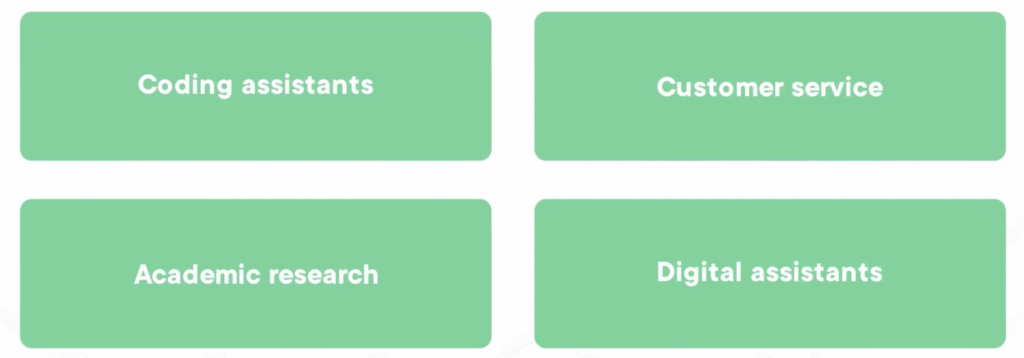
In coding, LLM agents like OpenAI’s codex are helping developers write and debug code faster. In customer service, they resolve issues with more nuance than old school bots. For researchers, they break down dense academic content into key takeaways. As a digital assistants, they go beyond reminders. They can draft emails, book appointments, and more.
Why Agentic AI?
Enable intelligent system to take initiative
Agentic AI shifts the role of AI from a passive tool to a proactive problem‑solver. It empowers machines to take initiative, not just respond, reducing the need for detailed, manual instructions at every step and making automation smarter and more scalable. This is particularly impactful in areas such as robotics, smart assistants, and complex workflows where independence is critical. Autonomy means the agent can make decisions and act without constant human oversight. These systems can assess a situation, determine the right time and method to act, and continuously monitor their environment to respond to changes—much like a self‑driving car adjusting to traffi
Degree of Autonomy
Agentic AI stands out for its high level of autonomy. However, not all autonomy is the same. Some systems act independently only in limited ways, and many still require human approval for high‑stakes decisions, such as confirming a financial transaction. Agentic AI pushes toward fuller autonomy, enabling systems to manage complex workflows with minimal human input.
Goal-directed Behavior
AI agents operate with a clear purpose in mind. Unlike reactive systems, agentic AI acts with intention: it aims to achieve goals, not just follow commands. Every action is evaluated in terms of progress toward those goals. When multiple goals exist, the agent can assess, prioritize, and even switch between them based on context.
For example, imagine an AI assistant managing your calendar. It schedules and reschedules based on your daily and weekly objectives. If a meeting is canceled, it doesn’t wait for your input—it reorganizes your time to preserve efficiency. It can even weigh different types of goals, such as productivity versus personal time, to help you maintain a balanced schedule.
Adaptive Planning
Another benefit of AI agents is their adaptability. Adaptive planning means the AI not only builds strategies but also updates them continuously as new information comes in. If something doesn’t go as expected, it adjusts rather than freezing or failing, which makes agentic systems more resilient in real‑world applications. Traditional automation simply executes pre‑written instructions; it doesn’t adapt or think. Agentic AI, on the other hand, is flexible: it senses, evaluates, and updates its behavior, making it better suited for messy, unpredictable environments where things rarely go according to plan.
Memory
It all begins with memory—the foundation of experience and adaptation in AI agents. AI agents store information from prior tasks, conversations, and events to improve performance over time. Short‑term memory helps manage the current context, while long‑term memory builds knowledge and experience across days or sessions. This enables agents to personalize responses, learn from behavior, and improve results based on feedback. A memory‑enabled agent can make smarter decisions by recalling past outcomes or user preferences, and in multi‑step interactions, memory provides critical continuity, helping the agent stay on track and avoid repetition.
Reasoning loops
Reasoning loops give agents the ability to revise and iterate on their answers. With reasoning loops, agents can self‑evaluate their outputs, much like checking their own work. They break down complex problems into smaller parts and explore different paths to a solution. This is useful in many applications, from writing and coding to data analysis and logical reasoning. Agents can also use these loops to optimize results over time by revising strategies or adjusting parameters. Overall, reasoning loops simulate deliberate, step‑by‑step thinking—a key trait of human‑level intelligence.
Tool Use
Tools act as extensions of the AI agent’s abilities. Tools connect the agent to external resources like APIs, databases, and cloud services. This enables real‑time access to information and lets agents perform tasks on the spot. With tools, agents can do more than talk. They can browse the web, run calculations, translate languages, and automate full workflows. This integration allows them to interact with software used in business environments like CRMs or productivity apps. Ultimately, tool use lets agents take action beyond their static training, bringing dynamic, up‑to‑date capabilities into play.
Environment interaction
Intelligent agents don’t just think—they act within an environment. Environment interaction means the agent can sense what’s happening around it and respond accordingly. This might be as physical as a robot reacting to obstacles, or as digital as a chatbot adjusting its tone based on user input. These agents are able to close the loop: they sense, decide, act, and then sense again. This ability to engage in real‑time, adaptive interaction is what makes them so effective in unpredictable, real‑world scenarios.
Challenges and Limitations
LLM agents, like any technology, have limitations. In longer conversations, they can lose track of context and still struggle with big‑picture planning, especially over extended time frames. Tool integrations can break if APIs are unstable or if responses are ambiguous. Prompts also matter—a change of just a word or two can lead to a very different outcome.
That said, the future of work with LLM agents is very bright. They are advancing rapidly, and we’re already seeing major improvements in their ability to reason and remember. Tech companies are now building agent ecosystems—teams of AI agents that collaborate on tasks. Longer‑term memory is on the horizon as well, enabling more personalized and context‑aware AI. From software engineering to customer support, this technology is poised to be truly transformative.