
Last Updated on August 15, 2026 by KnownSense
The integrity of AI and machine learning models depends entirely on the quality of their training data. When you build an ML system, you assume your data reflects reality. But what happens when an attacker manipulates that foundation?
Data poisoning attacks exploit this fundamental dependency. By altering the training data, attackers can manipulate the behavior of AI systems in subtle but dangerous ways. The model learns what you teach it. If you teach it corrupted patterns, it will faithfully reproduce them in production.
This is not a theoretical risk. From recommender systems to autonomous vehicles, data poisoning poses real threats across industries. Understanding how these attacks work is the first step in defending against them.
What Is a Data Poisoning Attack?
Data poisoning attacks occur when an attacker introduces misleading or false data into a system’s training set. The goal is to cause the model to make inaccurate predictions or decisions. The manipulation is often subtle, designed to evade detection while systematically corrupting the model’s learning process.
Think of it like poisoning a well. A small amount of contamination, introduced at the source, affects everyone who drinks from it. Similarly, poisoned training data corrupts every prediction the model makes.
The attack works because most learning algorithms assume their training data comes from a natural or well-behaved distribution. This assumption holds in academic settings. It does not hold in security-sensitive environments where adversaries actively manipulate your inputs.
How Data Poisoning Attacks Work
The attack follows a deceptively simple pattern. First, the attacker identifies a vulnerability in your data collection or training pipeline. Then they inject carefully crafted poisoned data into your dataset. This poisoned data gets included in your training process. The model learns the wrong patterns. When deployed, it produces erroneous outputs on specific inputs.
Those erroneous outputs then propagate into real-world applications. They lead to incorrect decisions. In some cases, they cause catastrophic failures.
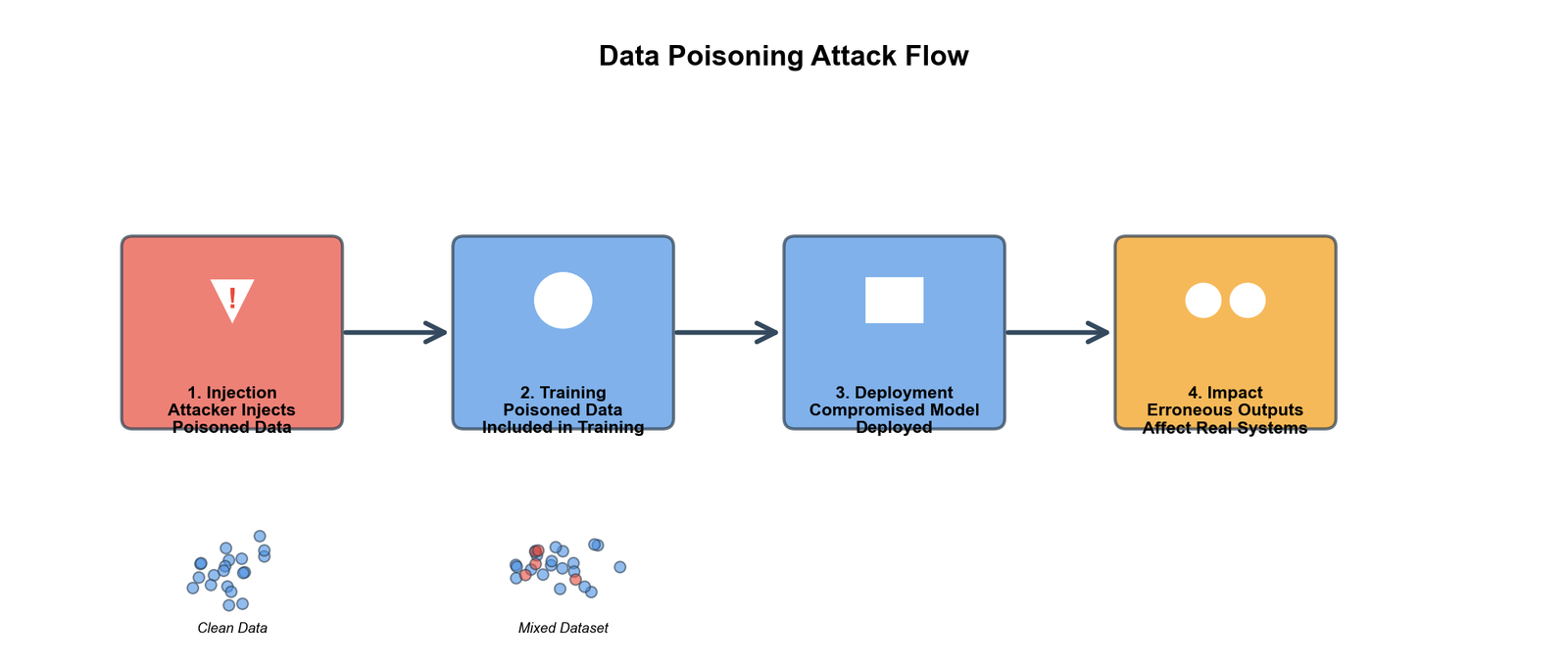
The diagram illustrates the complete attack chain. Clean training data gets contaminated. The ML model ingests this corrupted dataset. The trained model then produces erroneous predictions when deployed. These bad predictions affect real users and systems.
A Real Research Example
Researchers investigating attacks against support vector machines (SVMs) demonstrated just how vulnerable these systems are. Their work showed that an intelligent adversary can predict how an SVM’s decision function will change when malicious input is introduced. With this knowledge, they can construct poisoned data that maximizes damage.
The attack uses a gradient ascent strategy. The gradient is computed based on properties of the SVM’s optimal solution. This method can be kernelized, which means the attack works even for nonlinear kernels. The attacker operates in the input space, making detection extremely difficult.
The results were striking. Their gradient ascent procedure reliably identified local maxima of the validation error surface. These attacks achieved significantly higher error rates than random label flips. The SVM was systematically vulnerable to carefully constructed poisoning attacks.
Reference: B. Biggio, B. Nelson, and P. Laskov, “Poisoning Attacks Against Support Vector Machines,” Proceedings of the 29th International Conference on Machine Learning (2012): 1807–14.
More recent work has shown that poisoning scales to modern systems: researchers have demonstrated practical poisoning of web-scale training sets and durable backdoors in large models, confirming the threat is not limited to classical classifiers.
Types of Data Poisoning Attacks
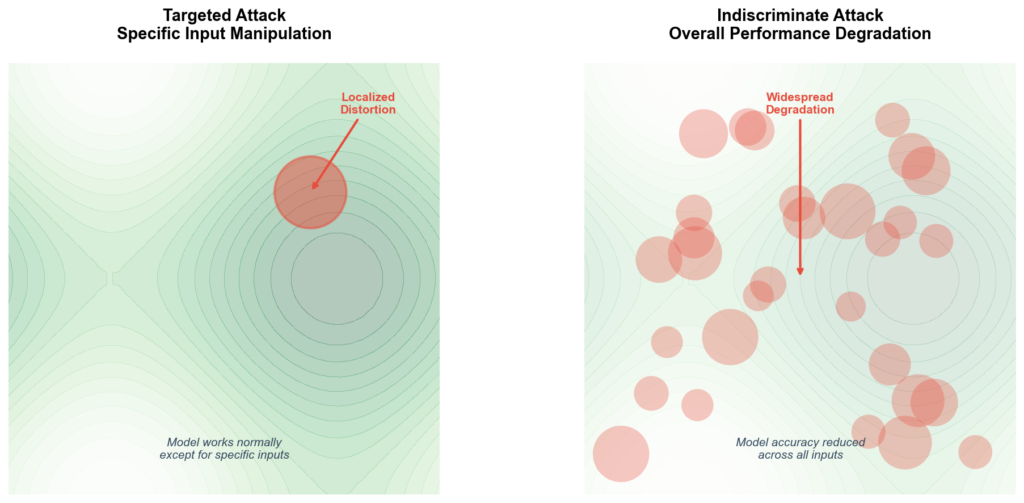
Data poisoning attacks fall into two main categories, each with different goals and different impacts.
Targeted Attacks
Targeted attacks aim to alter the model’s behavior for specific inputs. The attacker intentionally manipulates training data to cause specific misclassifications. For example, maybe they want a spam filter to allow one particular message through. Maybe they want a fraud detection system to ignore one specific transaction pattern.
The attack is surgical. The model performs normally in most cases. Only the targeted inputs produce the desired incorrect behavior. This makes detection harder because overall model performance metrics may not degrade significantly.
Indiscriminate Attacks
Indiscriminate attacks aim to decrease the overall performance of the model. The attacker’s goal is to degrade accuracy or effectiveness across a wide range of inputs. This is a blunt instrument compared to targeted attacks.
Why would someone do this? Sometimes the motive is to undermine trust in an AI system. In other cases, the goal is competitive advantage — sabotaging a rival’s model. Occasionally, the aim is simply to cause chaos and demonstrate vulnerability.
Real-World Examples
Data poisoning is not confined to research papers. It happens in production systems you interact with every day.
Recommender Systems
Consider a product recommender system. Malicious actors can manipulate ratings to artificially inflate a product’s popularity. They can also degrade a competitor’s reputation through negative rating attacks. The recommender system learns from this poisoned data. As a result, it then recommends products based on fake signals rather than genuine user preferences.
This is not hypothetical. Rating manipulation campaigns have been documented across major e-commerce and review platforms.
Social Networks and Misinformation
Social networks face a constant battle against data poisoning through bot networks. Bots spread misinformation and fake news at scale. This effectively poisons the data that feeds into information propagation models.
The impact extends beyond individual posts. These attacks influence public opinion, manipulate trending topics, and shape political discourse. The ML models that rank content, detect spam, and recommend posts are trained on this poisoned data stream.
Autonomous Systems
The stakes get higher in safety-critical systems. Imagine a self-driving car that has been trained on poisoned data. It might fail to recognize stop signs under certain lighting conditions. Similarly, it might misclassify pedestrians wearing specific patterns.
Healthcare AI systems face similar risks. A model trained on poisoned medical imaging data could miss cancers or generate false positives. Here, the consequences are measured in human lives.
.
The OWASP Perspective
The Open Web Application Security Project (OWASP) recognizes data and model poisoning as LLM04 in the 2025 edition of its Top 10 for Large Language Model Applications. They define it as tampering with training data that impairs model responses, compromising security, accuracy, or ethical behavior.
This recognition matters because it positions data poisoning alongside other critical vulnerabilities like prompt injection and supply chain attacks. If you are building applications with large language models, data poisoning is not a nice-to-have concern. It is a top-tier security risk.
Impact and Consequences
The impacts of data poisoning attacks vary based on the system that has been compromised. At minimum, these attacks cause financial losses and reputational damage. Customers lose trust when your AI system makes obviously wrong decisions.
In critical systems, the consequences escalate. Healthcare systems make wrong diagnoses. Financial systems approve fraudulent transactions. Autonomous vehicles make dangerous driving decisions. Ultimately, the damage is not just financial. It is physical and potentially fatal.
There is also a systemic risk. If attackers can reliably poison training data, the entire foundation of machine learning becomes questionable. How do you trust any model when you cannot trust its training data?
Defense Strategies
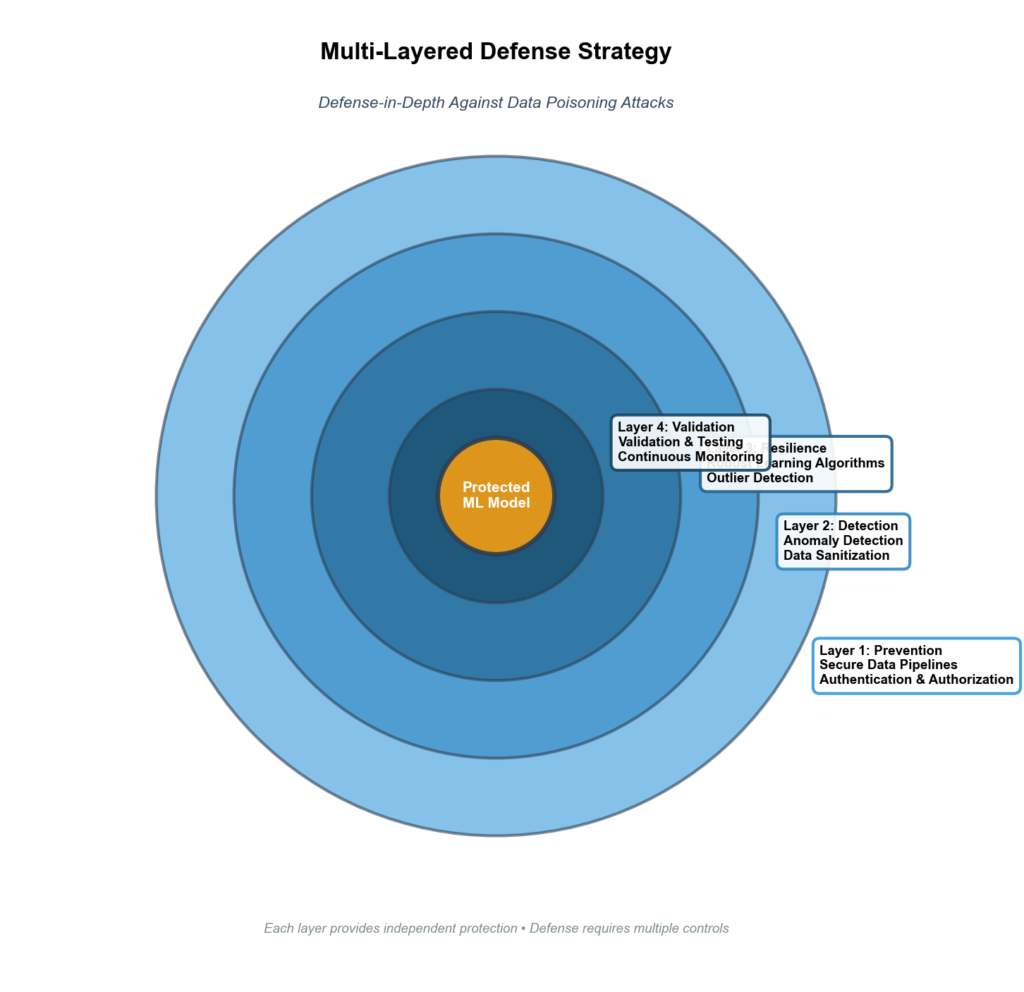
Defending against data poisoning requires multiple layers of protection. These layers fall into two groups: controls that prevent poisoning from entering your pipeline (secure data sources, sanitization) and controls that detect it once it has (anomaly detection, continuous validation).
Robust Learning Algorithms
Some learning algorithms are more resistant to poisoning than others. Research into robust learning focuses on algorithms that can tolerate a certain percentage of corrupted training data. For instance, these algorithms use techniques like outlier detection and weighted training to reduce the impact of poisoned samples.
You cannot eliminate the risk, but you can reduce the attack surface.
Data Sanitization
Data sanitization involves cleaning your training data before it reaches your models. This includes statistical analysis to detect anomalies, filtering suspicious data points, and validating data sources.
The challenge is that sophisticated poisoning attacks are designed to look like legitimate data. Your sanitization process must be intelligent enough to detect subtle patterns of manipulation.
Anomaly Detection
Anomaly detection systems can identify unusual patterns in training data or model behavior. If your model suddenly starts making systematic errors on inputs it previously handled correctly, that is a signal worth investigating.
Real-time monitoring during training can catch poisoning attacks in progress. You need baselines for normal data distribution and model performance. Consequently, deviations from those baselines trigger alerts.
Secure Data Pipelines
Prevention is better than detection. Secure your data sources and pipelines from the start. Use authentication and authorization to control who can contribute training data. Implement audit logs so you can trace data lineage. Encrypt data in transit and at rest.
Think of your training pipeline the way you think about production deployment pipelines. Both need security controls appropriate to their criticality.
Validation and Testing
Before deploying a model, test it extensively against adversarial examples and edge cases. Red team exercises where security experts attempt to poison your training data can reveal vulnerabilities before attackers exploit them.
Continuous validation in production catches drift and degradation. If your model’s behavior changes unexpectedly, investigate whether data poisoning is the cause.
| Strategy | What it does | Type |
|---|---|---|
| Robust learning algorithms | Tolerates a fraction of corrupted data | Prevention |
| Data sanitization | Cleans/filters data before training | Prevention |
| Secure data pipelines | Controls who can contribute data | Prevention |
| Anomaly detection | Flags unusual data or model behavior | Detection |
| Validation & testing | Catches drift and adversarial failures | Detection |
Future Challenges
Data poisoning attacks will evolve as AI systems become more sophisticated. As models grow larger and training datasets expand to billions of examples, manual inspection becomes impossible. Automated defenses must scale accordingly.
The research on poisoning attacks against SVMs pointed to several areas for future work. These include developing better optimization methods that can handle larger changes to training data, computing the largest possible step that does not alter the model’s structure, and exploring multi-point attacks that inject poisoned data at multiple locations.
These are not just academic questions. As attackers develop more sophisticated techniques, defenders must stay ahead of the curve.
Building Trustworthy AI Systems
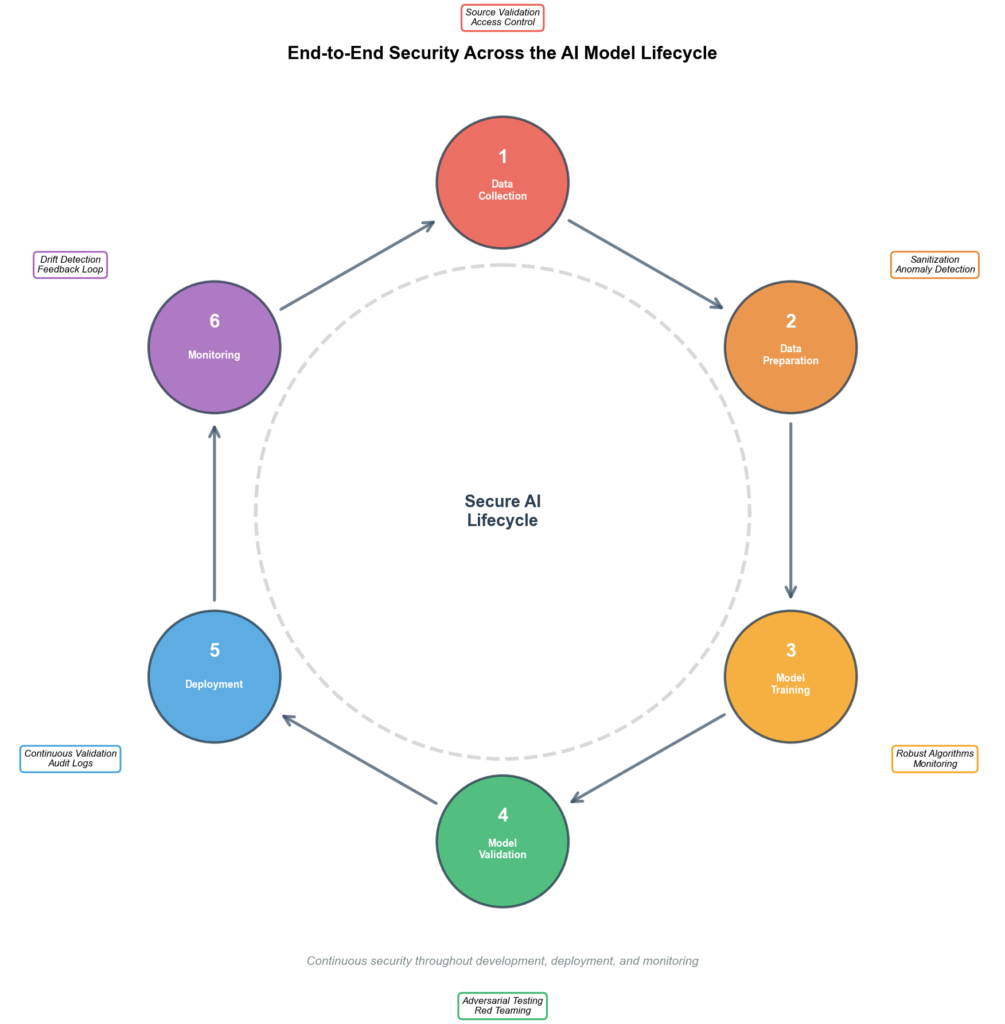
Data poisoning attacks remind us that AI security is not just about protecting models in production. It is about protecting the entire lifecycle, from data collection through training to deployment.
You need to think systematically. Where does your training data come from? Who has access to it? How do you validate its integrity? What happens if poisoned data gets through your defenses?
These are not optional questions. They are fundamental to building AI systems that people can trust. The integrity of your models starts with the integrity of your data.
If you treat your training data as a trusted resource without verification, you are building on sand. Assume that adversaries will attempt to manipulate your data. Design your systems accordingly. The models you deploy are only as reliable as the data you train them on.
Conclusion
Data poisoning is among the most insidious threats to AI systems. Unlike attacks on deployed models, it strikes at the foundation, the training data itself, so a compromised model can pass testing yet fail catastrophically on specific production inputs. It exploits the very nature of machine learning: models learn patterns without distinguishing genuine ones from malicious ones. You are not breaking into the system; you are teaching it to fail.
As AI moves into critical infrastructure, the stakes rise. Spam filters, fraud detection, medical diagnostics, and autonomous vehicles all depend on clean data. Defense requires vigilance across the whole pipeline: secure your data sources, validate incoming data, use robust algorithms, monitor behavior, and test against adversarial examples. No single layer suffices. And the problem is organizational as much as technical. Who has access to training data, and how do you audit changes to it, matters as much as the controls themselves. The principle is unchanged: the integrity of your AI systems depends on the integrity of your data. The question is not whether attackers will try to poison it, but whether you will be ready when they do.